

Become a Surgical Coach
For surgeons who want to coach others.
A 6-hour hybrid training course grounded in a decade of research. Learn evidence-based coaching methodology, earn certification and CME credit, and join a growing community of over 400 surgical coaches.
What a Surgical Coach Does
Surgical coaches unlock potential. They provide objective, constructive feedback that helps surgeons recognize what is working, identify what can improve, and build a plan to close the gap. Coaches help surgeons learn rather than teaching them. It is a fundamentally different skill, and it produces fundamentally different results.
As a surgical coach, you will meet with other surgeons face-to-face or online, using proven coaching techniques to guide them toward their own performance breakthroughs. You set your own schedule, and our administrative team handles the coordination.
Why Become a Coach
Coaching creates a unique professional relationship. While helping your colleagues improve, you sharpen your own practice. You build connections with surgeons across institutions. You join a community of professionals who believe that excellence is not a destination but a discipline.
Every surgical coach receives an honorarium for their work, CME credit, a digital badge to display on their professional profiles, and membership in the Academy’s surgical coaching community with first access to key insights and updates.
The Training
Over the past decade, we have developed and refined a coaching curriculum tested in multi-center clinical trials. Over 400 surgeons have become certified coaches through our 6-hour hybrid course that teaches the key principles of surgical coaching through a blend of self-paced learning and live practice.
- 5 hours of asynchronous didactics: Complete on your own time, at your own pace. Covers coaching methodology, communication strategies, and evidence-based feedback techniques.
- 90-minute live virtual session: Practice your new skills with faculty guidance and receive real-time feedback.
- Certification: Upon completion, you receive a Certificate of Surgical Coaching and join the Academy’s roster for coach-coachee matching.
CME Credit
This course is accredited through the American College of Surgeons. Completion earns CME credits that count toward the American Board of Surgery’s Continuous Certification requirements.
Investment
$1,000 per person.
You became a surgeon to make a difference in the OR. Coaching lets you make one far beyond it.
Peer Coaching Partnership Program
Coaching is a skill that gets sharper with practice. Practice it with a peer who gets it.
The Academy now offers a Peer Coaching Partnership Program that pairs certified coaches with one another for reciprocal coaching practice. You take turns as coach and coachee, refining your skills, gaining self-awareness, and exchanging techniques in a confidential, low-pressure environment.
How It Works
The Academy matches you with a compatible certified coach. Over four sessions, you alternate roles. One session, you coach. The next, you receive coaching on your own challenges. Both sides of that exchange make you better at what you do.
Why It Matters
- Test new coaching approaches in a safe, supportive setting with a peer who understands the work.
- Exchange specialized techniques and strategies from different surgical coaching contexts.
- Gain insight into your own coaching style, strengths, and blind spots.
- Stay sharp and continuously develop your coaching competencies.
Investment
$100 per coach for four peer coaching sessions.
The best way to sharpen your coaching is to experience it from both sides.
Contact us to Join the Next Cohort
Continuing Medical Education Credit Information
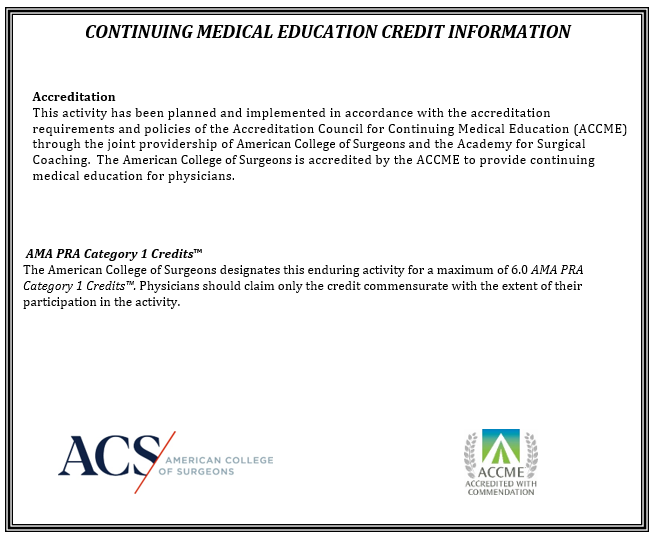
Accreditation
CME
Award of CME credits by ACS is based on compliance of the program with the ACCME accreditation requirements and does not imply endorsement by ACS of the content, the faculty, or the sponsor of the program.
Successful completion of this CME activity, which includes participation in the evaluation component, enables the learner to earn credit toward the CME requirements of the American Board of Surgery’s Continuous Certification program.
Diplomates of the American Board of Surgery
By attending an ACS-accredited activity, you may choose to participate in the automatic transfer of your CME credits to the ABS via the ACCME. The direct automatic transfer applies to all learners who have an American College of Surgeons (ACS) profile, are Diplomates of the ABS, and have provided their ABS ID and date of birth in the ACS MyCME Portal on the Board Certification page.
If you do not already have an American College of Surgeons (ACS) profile (Learner ID), you can create one through the ACS New User Registration Form. This is a free offering for those who have enrolled in an ACS- Accredited educational activity. The ACS ID will grant you access to MyCME where you can track, manage, and send your CME Data to the ABS.
If you need assistance with creating an ACS Learner ID or are not certain if you already have one, please contact Log-In Help.
For more information or to request assistance, contact mycme@facs.org
PROGRAM OBJECTIVES
This activity is designed for Surgeons. Upon completion of this course, you will be able to:
- Describe the current performance gap that can be met by Surgical Coaching
- Identify core principles of the coaching mindset
- Identify the key skills of surgical coaching
- Apply skills of Surgical Coaching within practice coaching sessions
RELEASE, REVIEW AND TERMINATION DATE
- Dates of the activity’s original release: 7/17/2024
- Review or update: 9/15/2025
- Termination date: 9/15/2028
DISCLOSURE INFORMATION
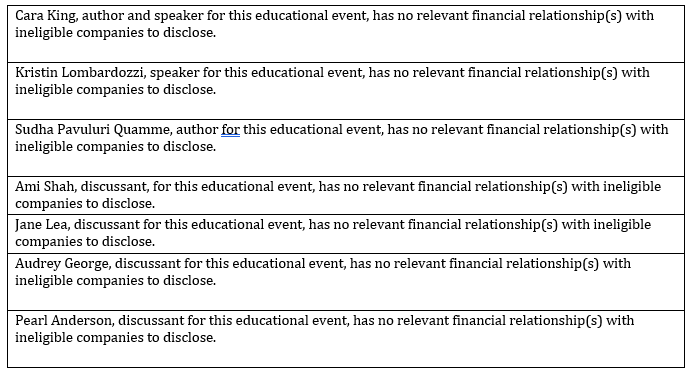
In accordance with the ACCME Accreditation Criteria, the American College of Surgeons must ensure that anyone in a position to control the content of the educational activity (planners and speakers/authors/discussants/moderators) has disclosed all financial relationships with any commercial interest (termed by the ACCME as “ineligible companies”, defined below) held in the last 24 months (see below for definitions). Please note that first authors were required to collect and submit disclosure information on behalf all other authors/contributors, if applicable.
|
Ineligible Company: The ACCME defines an “ineligible company” as any entity producing, marketing, re-selling, or distributing health care goods or services used on or consumed by patients. Providers of clinical services directly to patients are NOT included in this definition. |
| Financial Relationships: Relationships in which the individual benefits by receiving a salary, royalty, intellectual property rights, consulting fee, honoraria, ownership interest (e.g., stocks, stock options or other ownership interest, excluding diversified mutual funds), or other financial benefit. Financial benefits are usually associated with roles such as employment, management position, independent contractor (including contracted research), consulting, speaking and teaching, membership on advisory committees or review panels, board membership, and other activities from which remuneration is received, or expected. |
| Conflict of Interest: Circumstances create a conflict of interest when an individual has an opportunity to affect CME content about products or services of an ineligible company with which he/she has a financial relationship. |
The ACCME also requires that ACS manage any reported conflict and eliminate the potential for bias during the educational activity. Any conflicts noted below have been managed to our satisfaction.
The disclosure information is intended to identify any commercial relationships and allow learners to form their own judgments. However, if you perceive a bias during the educational activity, please report it on the evaluation.
Source: ACCME
Disclosure Information
In accordance with the ACCME Accreditation Criteria, the American College of Surgeons must ensure that anyone in a position to control the content of the educational activity (planners and speakers/authors/discussants/moderators) has disclosed all relevant financial relationships with any ineligible company held in the last 24 months. All reported conflicts are managed by a designated official to ensure a bias-free presentation. Please note that first authors were required to collect and submit disclosure information on behalf of all other authors/contributors, if applicable.
Funding for the original development of this project was provided by the University of Wisconsin-Madison School of Medicine and Public Health and Department of Surgery from the Wisconsin Partnership Program.
Make A Difference. Become A Surgical Coach.
The first step for becoming a Surgical Coach is to attend a Surgical Coach training course. Browse our upcoming training courses.
Register for Coach TrainingClient Testimonial
“The idea that a top athlete wouldn't have a coach is absurd. So the concept that
surgeons don't require a coach is crazy.”